
SEC climate disclosure rules: what they mean for ESG jobs in 2026
SEC climate disclosure rules don't just change what companies report — they change who companies need to hire. Here's the job map for 2026.

Vivek JamwalMay 18, 2026 · 8 min read
Most US companies think CSRD is a European problem. It isn't. Here's how to find out if you're in scope — and which roles you need to hire first.

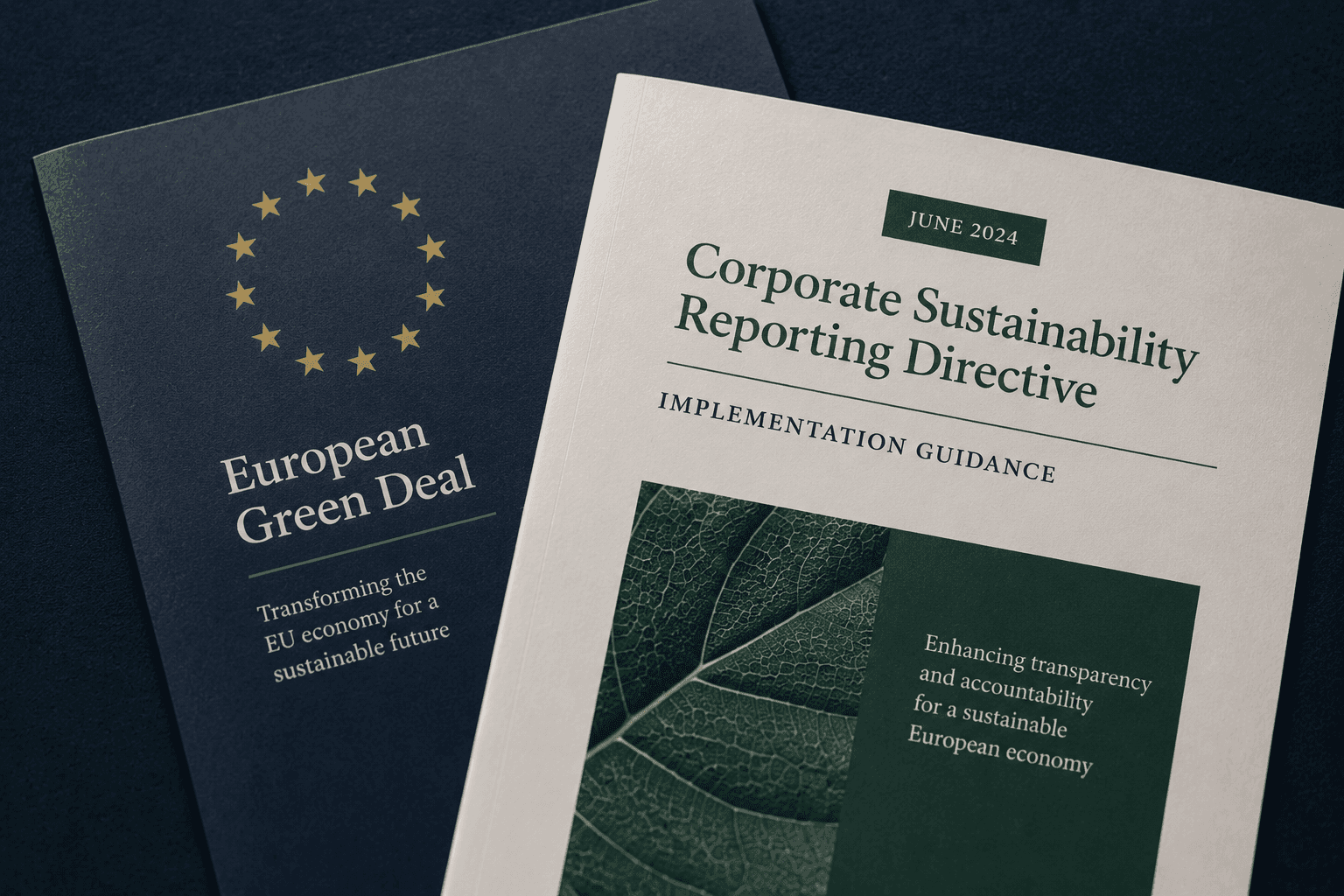
CSRD — the EU's Corporate Sustainability Reporting Directive — came into force in 2024. Most US HR teams heard about it, assumed it was a European problem, and moved on.
A significant number of them were wrong.
CSRD is the most comprehensive mandatory sustainability reporting framework ever enacted. It covers everything from greenhouse gas emissions to supply chain due diligence to board governance — and it applies not just to EU companies, but to a substantial subset of US companies with European operations, investors, or revenue. The roles it requires don't exist yet at most of those companies. The deadlines are closer than most legal teams have communicated to their HR counterparts.
This article answers the first three questions every US HR director should be asking: Are we in scope? What does compliance actually require us to do? And who do we need to hire?
Most US companies assume CSRD applies only to EU-headquartered businesses. That assumption misses three distinct routes to applicability.
Route 1 — The EU subsidiary route
If your US company owns an EU subsidiary that meets CSRD's size thresholds — 250 or more employees, OR €40 million or more in annual revenue, OR €20 million or more on the balance sheet, meeting at least two of those three criteria — that EU subsidiary must report under CSRD. And here's what most parent companies miss: that report requires sustainability data from the global group, including the US parent. A US HQ with no sustainability function cannot support a European subsidiary's CSRD report from the outside.
Route 2 — The EU-listed route
US companies with securities listed on an EU regulated market — bonds, shares, or other financial instruments — are in scope regardless of where the company is headquartered.
Route 3 — The large non-EU company route
This is the route most US companies miss entirely. Companies generating net revenue of €150 million or more in the EU, with at least one EU subsidiary or branch, are required to report under CSRD — regardless of whether they have significant EU employees or a major EU operational footprint. For a US company selling into European markets through a European branch office, this threshold can be reached without the company ever thinking of itself as significantly European.
Quick scope check:
Do you have an EU subsidiary with 250+ employees or €40M+ revenue? → Likely in scope now
Do you have EU-listed securities? → In scope
Do you generate €150M+ in EU revenue with any EU presence? → Check your 2026 filing requirements immediately
If any answer is yes, continue reading. If all are no, bookmark this article — the thresholds are designed to expand over time.
CSRD reports against the European Sustainability Reporting Standards (ESRS) — 12 topic areas covering climate, pollution, water, biodiversity, workers in the value chain, affected communities, consumers, and governance. But before any of those disclosures can be produced, four operational workstreams need to exist and be staffed.
Workstream | What it involves | Who owns it |
|---|---|---|
Double materiality assessment | Identifying which sustainability topics are material from impact and financial perspectives | Double Materiality Lead or ESG Strategy Director |
ESRS data collection | Gathering data across all material topic areas, often from systems that don't currently track this information | ESRS Reporting Manager |
Value chain data | Supplier and customer sustainability data — Scope 3 effectively required for climate-material companies | Scope 3 / Value Chain Analyst |
Third-party assurance | Managing limited assurance engagement over sustainability disclosures | Sustainability Assurance Coordinator |
A note on double materiality, because it's the workstream most US companies underestimate:
Unlike the SEC's approach — which focuses on how climate affects the company financially — CSRD's double materiality requires companies to assess topics from two directions simultaneously. Impact materiality asks how the company affects people and the environment. Financial materiality asks how sustainability issues affect the company's finances. A topic can be material on one dimension, both, or neither. The double materiality assessment determines which ESRS requirements apply — and it needs to be conducted by someone who understands the methodology, not reverse-engineered from the report template.
Get the weekly green briefing
No noise. Just insights.
Five hiring priorities emerge directly from the four workstreams above.
Double Materiality Lead — $95,000–$130,000
Runs the DMA process: stakeholder engagement, impact identification, topic prioritization, materiality matrix. This is the most conceptually complex role CSRD creates. ESG strategy backgrounds and Big 4 sustainability advisory experience are the clearest pathways. Someone who has run a GRI materiality assessment has directly transferable process knowledge.
ESRS Reporting Manager — $90,000–$125,000
Owns ESRS data collection across all material topic areas and produces the final sustainability statement. This role is structurally similar to a GRI or integrated report manager — the framework is different, the rigor is higher. ESRS familiarity is increasingly available among candidates who've worked on European company reporting teams or Big 4 CSRD advisory engagements.
Scope 3 / Value Chain Analyst — $75,000–$100,000
Manages supplier and customer data collection for value chain emissions and other ESRS value chain requirements. For companies where climate is a material topic under the DMA — which includes most large industrial, consumer goods, and financial services companies — Scope 3 emissions disclosure is effectively required. Supply chain, procurement, and carbon accounting backgrounds all qualify.
Sustainability Assurance Coordinator — $85,000–$115,000
Manages the company's limited assurance engagement. CSRD requires limited assurance from the start, with a pathway toward reasonable assurance over time. Public accounting and Big 4 audit backgrounds are the clearest qualification — the process of managing an assurance engagement is structurally familiar; the subject matter (sustainability data vs financial data) is what's new.
Head of Sustainability / ESG Director — $140,000–$220,000
Senior ownership of the CSRD program at group level, including board-level reporting and accountability. This role is the program anchor — without it, the four functions above operate without coordination or strategic direction. For smaller US subsidiaries in scope, this function can be partially served by an existing executive with expanded mandate, combined with external advisory support in year one.
Three mistakes that are common enough to be worth naming directly.
Treating CSRD as a one-time project
The instinct for many US companies is to hire a consultant to "do the CSRD report" and consider the problem solved. CSRD reporting is annual. The double materiality assessment must be refreshed as the business and its context evolve. The ESRS standards are still being developed and amended. Companies that treat the first report as a deliverable rather than the start of a function will rebuild from scratch every year — at significantly higher cost than maintaining the capability in-house.
Underestimating how much new data needs to be collected
The ESRS covers 12 topic areas. Most US companies have robust financial data and increasingly good climate data. They have almost none of the worker welfare, biodiversity, pollution, or community impact data that ESRS requires for material topics. The first year of CSRD compliance is largely a data audit — identifying what exists, what doesn't, and what systems need to be built or modified to collect it going forward. That's not a report-writing exercise. It's an operational transformation.
Assuming the EU subsidiary can handle it without group-level support
A European subsidiary with 300 employees cannot produce a CSRD report using only data from those 300 employees. The report covers the consolidated group. Scope 3 extends into the global supply chain. Governance disclosures extend to the board of the parent company. The sustainability function needs to exist at group level — not just in the EU entity — for CSRD compliance to be operationally feasible.
CSRD is creating a category of sustainability roles at US companies that didn't exist 18 months ago — and the candidate pool with direct CSRD experience is extremely small, which creates a genuine first-mover advantage.
The candidates best positioned right now:
GRI or TCFD reporting professionals (ESRS is structurally similar; the learning curve is steep but the foundation transfers)
Double materiality practitioners from European companies or Big 4 advisory teams
Scope 3 analysts with value chain data experience
Sustainability assurance professionals from Big 4 or specialist assurance providers
Where to find these roles: in-house at US subsidiaries of EU companies already in the first reporting wave, at large US companies in the €150M EU revenue scope building their first sustainability function, and at Big 4 and boutique ESG consulting firms servicing CSRD compliance engagements for multiple clients simultaneously.
Entity type | First reporting year | Data year | Assurance level | Scope 3 required |
|---|---|---|---|---|
Large EU subsidiaries (met thresholds by FY2024) | 2025 | FY2024 | Limited | If climate is material |
Mid-size EU subsidiaries (met thresholds FY2025) | 2026 | FY2025 | Limited | If climate is material |
Large non-EU companies (€150M+ EU revenue) | 2029 | FY2028 | Limited | If climate is material |
SME EU subsidiaries | Voluntary / TBD | — | — | — |
The companies that started building their CSRD compliance function in 2024 are already a year ahead. The ones starting now are behind — but not out of time, if they move in the next six months.
Share this article

Founder of EcoRoles. I write about sustainability careers, ESG hiring trends, and the green economy — for professionals navigating the transition and teams building it.
LinkedIn