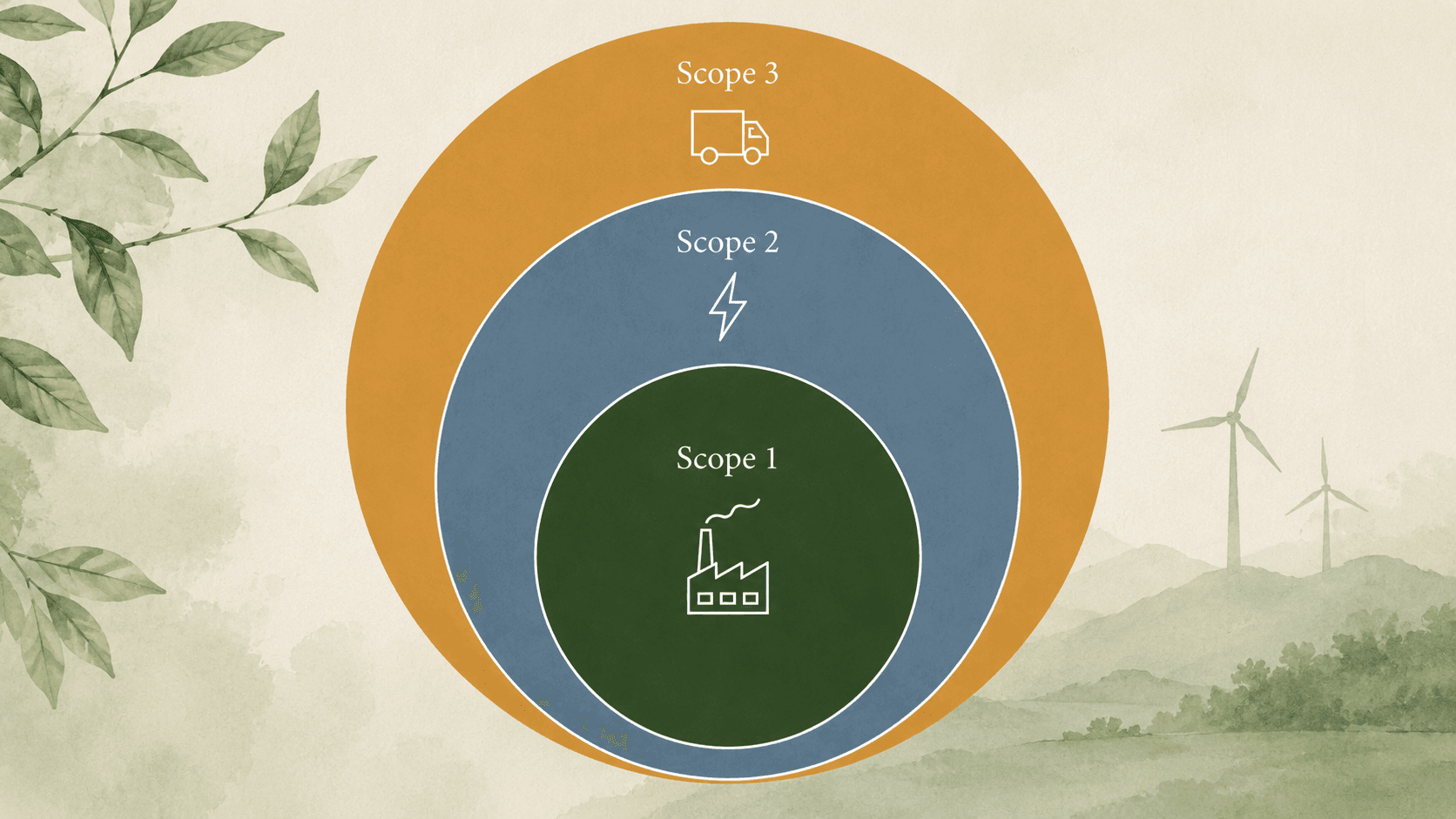
Scope 2 covers emissions from the generation of electricity, steam, heat, or cooling that the company purchases but doesn't generate itself. The emissions happen at the power plant — but because the company consumes the energy, they count in the company's footprint.
Two accounting methods exist, and knowing the difference matters in interviews:
Location-based method: Uses the average emissions intensity of the regional electricity grid. Simpler to calculate, but doesn't reflect whether a company has made specific renewable energy purchases.
Market-based method: Uses contractual instruments — Power Purchase Agreements (PPAs), Renewable Energy Certificates (RECs), or supplier-specific emission rates. Reflects deliberate procurement choices. Most companies that have made renewable energy commitments report using the market-based method.
"Scope 2 is where most companies start their decarbonization journey because it's the most controllable — you can switch your electricity supplier or sign a PPA. Scope 3 is where the real measurement work begins."
Jobs that own Scope 2
Scope 2 is the domain of energy procurement, renewable energy strategy, and sustainability reporting (the energy data layer specifically).
Job title | What they own in Scope 2 |
|---|
Renewable Energy Procurement Manager | PPA negotiation, REC procurement, RE100 strategy |
Energy Analyst | Utility data management, location vs market-based accounting |
Sustainability Reporting Analyst | Scope 2 data collection and verification |
Clean Energy Project Manager | On-site solar, battery storage, grid interconnection |
Background that transfers: Energy engineers, utility analysts, procurement professionals, and anyone who's worked with utility billing data or energy contracts.
Scope 3 — Everything Else (and Why It's the Hardest Job in Sustainability)
Scope 3 is where most of the complexity, most of the hiring demand, and most of the unresolved measurement challenges sit.
Definition: All indirect emissions in the company's value chain that aren't covered under Scope 1 or 2. This includes both upstream (what goes into making your product) and downstream (what happens after your product leaves your control).
The GHG Protocol divides Scope 3 into 15 categories. Rather than listing all 15, here's how they group by function:
Upstream Scope 3 (what goes into your operations):
Purchased goods and services — emissions from producing everything you buy
Capital goods — emissions from manufacturing the equipment you use
Fuel and energy-related activities not in Scope 1 or 2
Upstream transportation and distribution
Waste generated in operations
Business travel
Employee commuting
Upstream leased assets
Downstream Scope 3 (what happens after you):
Downstream transportation and distribution
Processing of sold products
Use of sold products — often the largest category for consumer goods companies
End-of-life treatment of sold products
Downstream leased assets
Franchises
Investments (largest category for financial institutions)
The critical stat: For most companies, Scope 3 represents 70 to 90 percent of total emissions. For a consumer electronics company, the use phase of its products dominates. For a bank, its loan portfolio and investments dwarf its office footprint. For a retailer, purchased goods from suppliers are the vast majority of its footprint.
This is why Scope 3 is both the hardest and the most valuable sustainability skill. The data doesn't come from a meter on the wall — it comes from supplier questionnaires, spend databases, industry averages, and estimation methodologies with significant uncertainty.
Jobs that own Scope 3
Scope 3 category group | Job title | Background that transfers |
|---|
Purchased goods (Category 1) | Scope 3 Analyst, Carbon Accountant | Finance, accounting, supply chain |
Supplier engagement | Supply Chain Sustainability Manager | Procurement, supplier relations |
Business travel and commuting | Sustainability Reporting Analyst | HR data, travel management |
Use of sold products | Product Sustainability Lead | Product management, engineering |
Investments (Category 15) | ESG Investment Analyst, Portfolio Carbon Analyst | Finance, asset management |
Full Scope 3 program | Sustainability Reporting Manager | Multi-functional, senior |
The Scope-to-Job Map: What This Means for Your Career
Here's the section every other Scope 1/2/3 explainer leaves out.
Knowing the three scopes isn't just useful for passing an interview question. It's a targeting tool. The scope a role works in tells you which background they're hiring for, which frameworks you need to know, and how hard the work actually is.
Scope | Primary job function | Example roles | Best-fit backgrounds |
|---|
Scope 1 | Operations decarbonization, energy efficiency | Energy Manager, Industrial Decarbonization Engineer | Mechanical/electrical engineering, facilities, operations |
Scope 2 | Renewable energy procurement, energy data | Renewable Energy Manager, Energy Analyst | Energy, procurement, utility data |
Scope 3 | Value chain measurement, supplier engagement | Carbon Accountant, Supply Chain Sustainability Manager, Scope 3 Analyst | Finance, accounting, supply chain, data analysis |
All scopes | Reporting, strategy, program management | Sustainability Reporting Manager, ESG Director | Multi-functional, senior leadership |
The career-targeting implication: A finance professional with supply chain experience is a natural Scope 3 hire. An energy engineer is a natural Scope 1 and 2 hire. A data analyst who's worked with utility billing or spend databases owns Scope 2 and Category 1 Scope 3. Stop applying generically — target by scope.
How to Talk About the Scopes in a Job Interview
Most Scope 1/2/3 explainers stop at definitions. That's the wrong place to stop — and it's what gets candidates eliminated in round two.
Hiring managers don't want candidates who can define Scope 3. They want candidates who understand the operational reality of measuring it. There's a significant difference.
Three things to know before any sustainability interview:
1. Which scopes the company currently reports. Check their CDP submission (public for companies that disclose) or their most recent sustainability report. If they report to CDP, their Scope 1, 2, and 3 figures and methodology are published. Arriving knowing these numbers is uncommon and memorable.
2. Which methodology they use for Scope 3. Spend-based is common for companies starting out — it uses financial spend data multiplied by emission factors and is faster to implement but less precise. Activity-based uses actual physical data (tonnes of goods purchased, liters of fuel used) and is more accurate but data-intensive. A company using activity-based Scope 3 has a more mature program.
3. Where their biggest data gaps are likely to be. Every Scope 3 program has gaps — categories with missing supplier data, categories estimated rather than measured, categories excluded with justification. Showing up able to identify likely gaps based on their industry signals genuine knowledge.
The wrong answer to "how would you improve our Scope 3 data quality?"
"I'd engage suppliers directly and improve the response rate."
The right answer:
"It depends on which categories are creating the most uncertainty. For Category 1 purchased goods, I'd look at whether a spend-based approach is obscuring high-emission suppliers — and whether moving the top 20 suppliers to activity-based data would materially change the inventory. For Category 11 use of sold products, I'd check whether the usage assumptions reflect actual customer behavior. The methodology choice matters more than the engagement rate."
One answer shows you know the term. The other shows you can do the work.
Scope 1, 2, and 3 aren't trivia for a sustainability interview. They're the structural backbone of every corporate emissions program — and by extension, every sustainability job.
The moment you understand which scope maps to your background and your target roles, your job search becomes significantly more targeted. You stop applying to every "sustainability" role and start applying to the ones where your specific skills are the answer to a specific problem.
That's how you compete in a market where everyone says they're passionate about climate.